
Fannin County Arrest Records and Court Charges
Arrest records document the arrest side of an event: the law-enforcement agency, booking or custody status when available, arrest date, and related charge information at that point in time. Fannin County Sheriff's Office and Adult Detention Center channels are the local custody and jail contacts, but the research did not locate an official Fannin online inmate roster or a sheriff mugshot database. That absence should not be filled with an unofficial source.
Court charges after arrest are different. They are the charges placed into the judicial process by prosecutor action, warrant application, accusation, indictment, or related filing. Once those charges become part of a criminal case, the court charge record is tracked through Magistrate Court events, Superior Court filings, and the Clerk of Superior Court case file. The full criminal case outcome belongs in Fannin County criminal court records, while jail custody details belong with inmate and detention channels.
The Fannin County Sheriff's Office homepage is assigned to this arrest records and court charges page. It provides sheriff, detention, and non-emergency contacts that are central when there is no official online arrest roster.

Use the sheriff source for custody and law-enforcement contact information, then use the court or prosecutor source to confirm filed charges and outcomes.
Find Fannin County Arrest Records
Fannin's search path starts with the type of information needed. For current custody, call the Adult Detention Center at 706-632-2045 because no official online jail roster was located. For arrest-related case events such as warrant applications, first appearances, and preliminary hearings, contact Magistrate Court. For felony charges filed into Superior Court, use the Clerk of Superior Court and Georgia provider routes. For city citations that become arrest warrants after failure to appear, contact the municipal court that issued the citation.
- Use the detention center for current custody, bond, and booking-process questions when the person may be in the Fannin jail.
- Use Magistrate Court for warrant applications, search warrants, first appearances, and preliminary hearings.
- Use the Clerk of Superior Court for felony case files, indictments, pleas, dispositions, and certified copies.
- Use Blue Ridge or McCaysville Municipal Court for city traffic or ordinance cases that may create a bench or failure-to-appear warrant.
- Use GBI record-restriction and criminal-history channels only for statewide criminal-history questions, not as a substitute for the local court file.
For sex-offender information, Fannin Sheriff links the GBI statewide registry and states the Sheriff's Office maintains the registry under O.C.G.A. 42-1-12. Sex-offender registry results are a separate statutory public-safety record, not a list of all Fannin arrests or court charges.
Charges Filed After Arrest
After an arrest, a charge can move through several legal forms. Fannin Magistrate Court handles warrant applications, search warrants, first appearances, preliminary hearings, and county ordinance violations. For felony cases, the Appalachian Judicial Circuit District Attorney reviews and prosecutes charges. The official DA page names Frank H. Wood as District Attorney and lists the Fannin office at the courthouse, phone 706-632-2496.
| Complaint / Warrant Application | Accusation | Indictment | |
|---|---|---|---|
| Filed or initiated by | Law enforcement, applicant, or court process depending on matter. | Prosecutor. | Grand jury. |
| Common use | Early criminal process, warrants, first appearance, or lower-court matters. | Some criminal prosecutions where prosecutor filing is allowed. | Felony prosecution in Superior Court. |
| Record location | Magistrate Court or issuing court. | Court case file. | Superior Court criminal case file. |
One arrest can produce no filed charge, one filed charge, or several charges. The arrest record may use the first suspected offense, while the court charge record may change after prosecutor review, indictment, plea talks, or dismissal.
Fannin Court Charge Status
Charge status changes as the court case moves. A pending charge is unresolved. An amended charge has changed from the original wording or level. A reduced charge has been lowered as part of a court or prosecutor action. A dismissed charge is no longer being pursued in that case. Nolle prosequi means the prosecutor declines to continue that charge. Always read the disposition for each count, not just the first charge listed.
| Status | What It Means |
|---|---|
| Pending | The charge remains open and has not reached final disposition. |
| Amended / reduced | The charge wording, statute, severity, or count has changed during the case. |
| Dismissed | The court or prosecutor ended that count without a conviction on that charge. |
| Nolle prosequi | The prosecutor chose not to proceed on that charge. |
| Convicted | The court accepted a guilty plea or entered a guilty finding on that count. |
Charges vs. Convictions
A charge is an allegation filed into the court process. A conviction is the result after a guilty plea, verdict, or other guilty finding. Fannin County arrest records and charge records can show allegations that never become convictions. This is why a background or case review should separate arrest date, charge list, disposition, and sentence.
| Charge | Conviction | |
|---|---|---|
| Timing | Appears after arrest, warrant, prosecutor filing, accusation, or indictment. | Appears after plea, verdict, or final guilty finding. |
| Meaning | Shows what was alleged at a point in the case. | Shows the court's final guilty outcome for a count. |
| Can change | Yes, charges may be amended, reduced, dropped, or dismissed. | Yes, but usually through appeal, modification, restriction, or later court order. |
Sealed and Restricted Charge Records
Georgia research supports careful wording. GBI explains O.C.G.A. 35-3-37 as the record-restriction statute for certain criminal-history records. For arrests after July 1, 2013, GBI says there is no application process through the arresting agency, and the person must contact the prosecutor. For arrests before that date, the person applies at the arresting agency. This is not the same as getting a court file sealed.
| Sealed Court Record | Georgia Record Restriction | |
|---|---|---|
| Record affected | Court case file or selected court documents. | Criminal-history access for non-criminal justice purposes. |
| Local path | Ask the court clerk what order or motion is required. | Use prosecutor or arresting agency route based on arrest date. |
| Public effect | Record may be hidden from ordinary public inspection. | Record may be limited in background-style criminal-history searches. |
Note: Juvenile charges and juvenile detention history should not be described as freely searchable public Fannin County records.
Charge Codes and Severity
Fannin charge records may refer to Georgia Code sections, local ordinance sections, or court-specific charge text. Felony charges usually belong in Superior Court because Georgia Superior Court has exclusive constitutional authority over felony cases. Municipal ordinance and traffic matters may remain with Blue Ridge or McCaysville Municipal Court. Magistrate Court is key early in the process for warrants, first appearances, and preliminary hearings.
Blue Ridge Municipal Court research shows how a lower-court matter can become an arrest issue. If a person with a city citation fails to pay or appear, the city page says a warrant for arrest will be issued, an additional contempt-of-court fine assessed, and the driver's license suspended. That warrant consequence is separate from the original citation and should be checked with the municipal clerk.
Statewide Arrest and Charge Lookups
Statewide tools answer different questions. GBI criminal-history and record-restriction materials address Georgia criminal-history access and limits. Georgia Department of Corrections searches sentenced state-prison offenders, not current Fannin County jail detainees. VINELink may provide custody status and notification options. The Fannin Sheriff's sex-offender page links the GBI public registry and states the Sheriff's Office maintains the registry under O.C.G.A. 42-1-12.
Statewide sources can be useful when local court records do not answer the whole question, but each source has a narrow purpose. GDC is for sentenced state-prison offenders. VINE is for custody notification. GBI record-restriction material explains when criminal-history access may be limited. The public sex-offender registry is a statutory registry. None of those tools replaces a Fannin Superior Court case file, Magistrate first-appearance record, or municipal court citation record.
The GBI public sex offender registry is a statewide registry source connected to the sheriff's statutory registry duties.
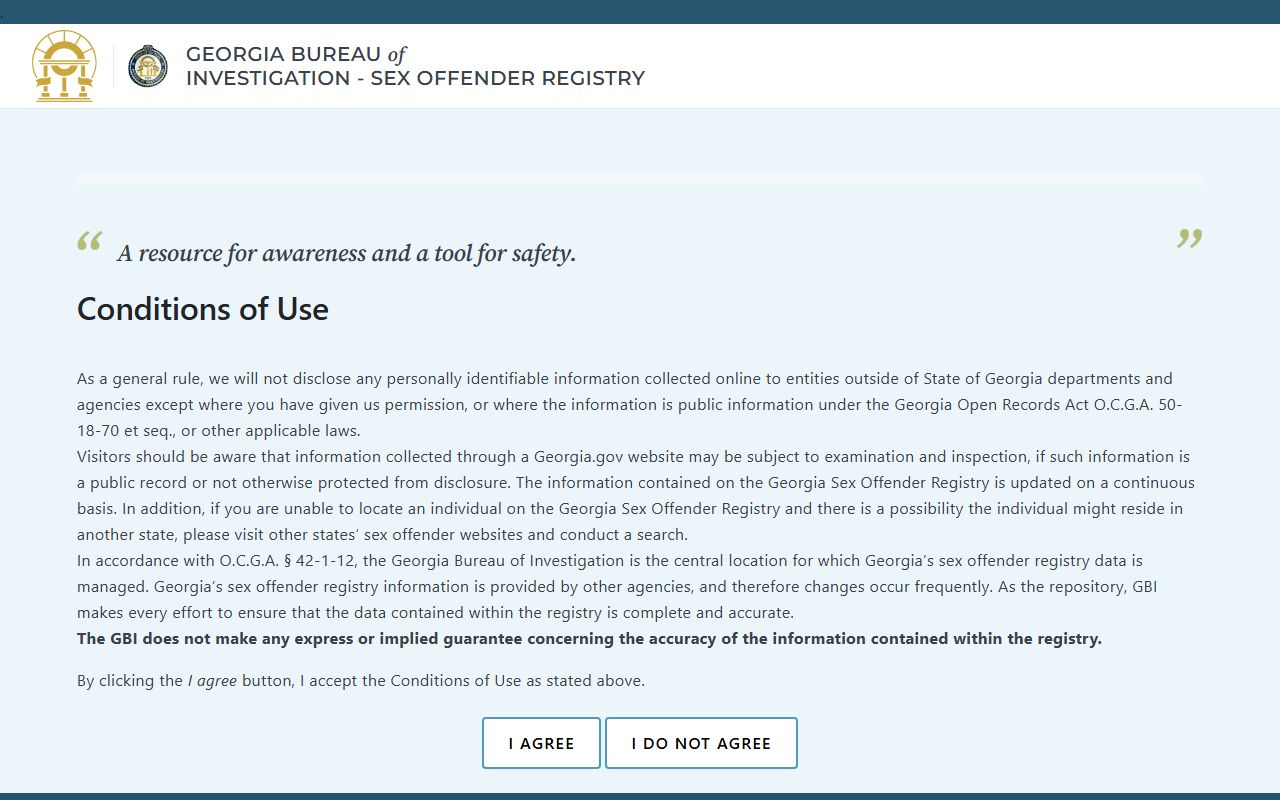
The registry is a public-safety registry, so it should be used for statutory sex-offender information rather than broad arrest or charge searching.
Restricted Fannin Charge Records
Restricted charge records may include juvenile matters, sealed charges, protected victim information, Social Security numbers, financial account numbers, medical details, confidential addresses, adoption-related records, or ongoing-investigation material. Uniform Superior Court Rule 21 allows limits on Superior Court access when ordered under the rule or required by law. Georgia Open Records Act exemptions may also affect law-enforcement or agency records.
For a charge record that does not appear online, use the local fallback chain. Call the court that may have issued the warrant or handled the first appearance. Call the Clerk of Superior Court for felony case records. Call the District Attorney's office for prosecutor-route restriction questions when GBI directs post-July 1, 2013 matters to prosecutors. Call the Detention Center only for jail custody and bond questions, not for certified court dispositions.
Recent official state releases in the research show why this distinction matters. GBI announcements may describe an arrest, an investigation, or a referral to the Appalachian Judicial Circuit District Attorney. Those releases are not the final court charge record. The filed court case, charge amendments, plea, dismissal, sentence, or restriction status must be checked with the court or prosecutor route that controls the case.